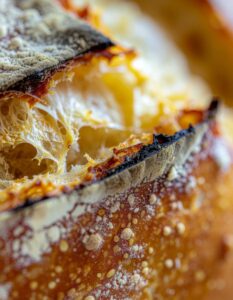
Artisan Sourdough Bread
Equipment
- Large mixing bowl
- Kitchen scale
- Bench scraper
- Banneton or proofing bowl
- Dutch oven
- Parchment paper
- Sharp blade or razor
Ingredients
- 100 g active sourdough starter fed and bubbly
- 375 g filtered water room temperature
- 450 g bread flour high protein
- 50 g whole wheat flour
- 10 g kosher salt
Instructions
- In a large mixing bowl, whisk together the active sourdough starter and water until well combined and slightly frothy.
- Add both flours to the bowl and mix with your hands or a wooden spoon until no dry flour remains. The dough will look shaggy. Cover and let rest for 30 minutes (autolyse).
- Add salt and mix thoroughly by hand, pinching and folding the dough until the salt is fully incorporated and the dough feels smooth, about 3-4 minutes.
- Begin bulk fermentation: Cover the bowl and let rest for 30 minutes, then perform the first set of coil folds by lifting the dough from one side and folding it over itself. Rotate the bowl 90 degrees and repeat on all four sides.
- Continue coil folding every 30 minutes for the first 2 hours (4 sets total), then let the dough rest undisturbed for 2-4 more hours until increased by 50-70% and feels light and airy.
- Turn the dough onto a lightly floured surface and shape into a loose round. Let rest 20 minutes, then perform final shaping into a tight boule or batard.
- Place seam-side up in a banneton or bowl lined with a floured kitchen towel. Cover and refrigerate overnight, or proof at room temperature for 2-4 hours until properly proofed.
- Place a Dutch oven with lid in the oven and preheat to 475°F for at least 45 minutes.
- Carefully turn the dough onto parchment paper, score with a sharp blade, and transfer to the hot Dutch oven using the parchment as a sling.
- Cover and bake for 20 minutes, then remove the lid, reduce temperature to 450°F, and bake 20-25 minutes more until deep golden brown with an internal temperature of 205-210°F.
- Cool completely on a wire rack for at least 1 hour before slicing to allow the crumb to set properly.
Notes
Storage: Keep wrapped in a kitchen towel for 2-3 days or slice and freeze for up to 3 months. The starter should double in size within 4-8 hours of feeding for best results. Fermentation times vary with temperature—cooler kitchens need longer times.
Nutrition
Calories: 165kcalCarbohydrates: 33gProtein: 6gFat: 1gSodium: 390mgFiber: 2g