

The Pot Roast That Fills the Whole House with That Smell
There is a particular kind of magic that happens when you lower a well-seasoned chuck roast into a slow cooker in the morning, tuck root vegetables around it, pour in a deeply savory braising liquid, and walk away. By the time dinner rolls around, your entire home smells like the coziest, most indulgent Sunday supper imaginable — warm with beef, rich with herbs, deeply savory in that bone-deep way that only long, slow cooking can produce. This is the kind of aroma that makes people wander into the kitchen just to lift the lid and breathe it in. And when that lid finally comes off for good, what you find inside is nothing short of extraordinary: beef so tender it yields to the gentlest pressure of a fork, vegetables bathed in glossy, herb-laced braising juices, and a gravy that tastes like it took you all day to make — because, in the best possible way, it did.
Slow Cooker Pot Roast is one of those rare recipes that delivers restaurant-quality results with minimal active effort, and this version is built entirely around the philosophy of maximum flavor. We are talking about a serious sear on the chuck roast before it ever touches the slow cooker — that caramelized, deeply browned crust is non-negotiable if you want layers of complexity in the final dish. We are talking about a braising liquid that is bold and savory: beef broth, Worcestershire sauce, tomato paste, and a generous hit of aromatics. And we are talking about a finish that elevates this from a crockpot meal to a genuine showstopper: the braising liquid gets reduced and thickened into a silky, glossy gravy that coats every bite. If you have ever settled for a bland, watery pot roast, consider this your redemption.
Whether you are feeding a hungry family on a weeknight, hosting a Sunday dinner that needs to feel effortless, or simply craving the kind of deep, stick-to-your-ribs comfort that only braised beef can provide, this recipe is your answer. It is indulgent, it is deeply satisfying, and once you make it this way, you will never go back.
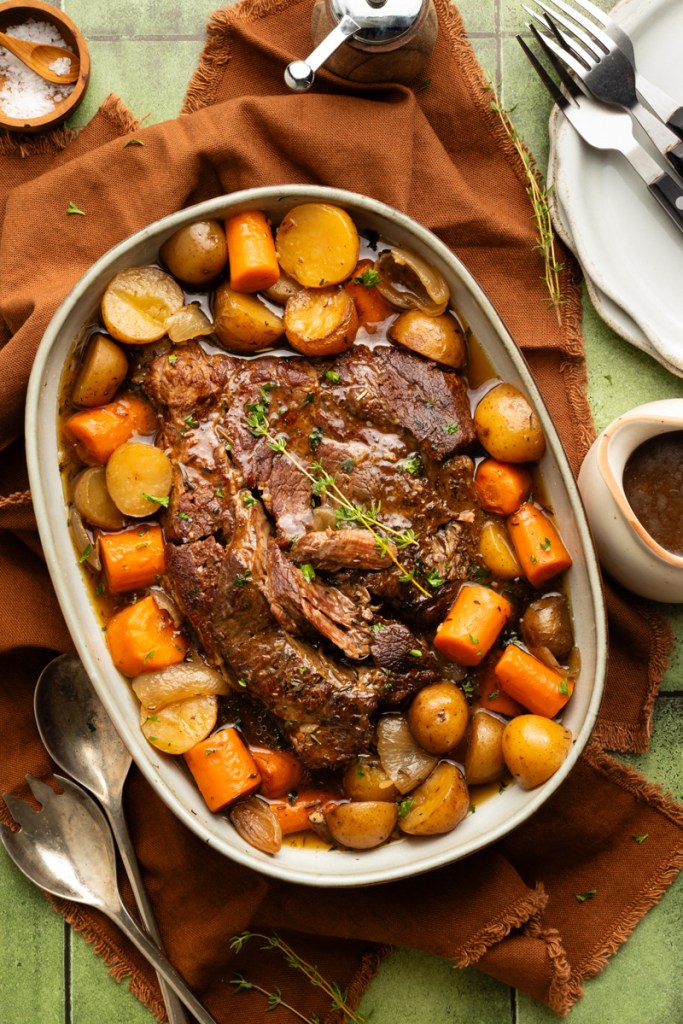
Why You’ll Love This Recipe
- Effortless, hands-off cooking: Fifteen minutes of active prep in the morning means a stunning dinner is ready when you need it — the slow cooker does 100% of the heavy lifting.
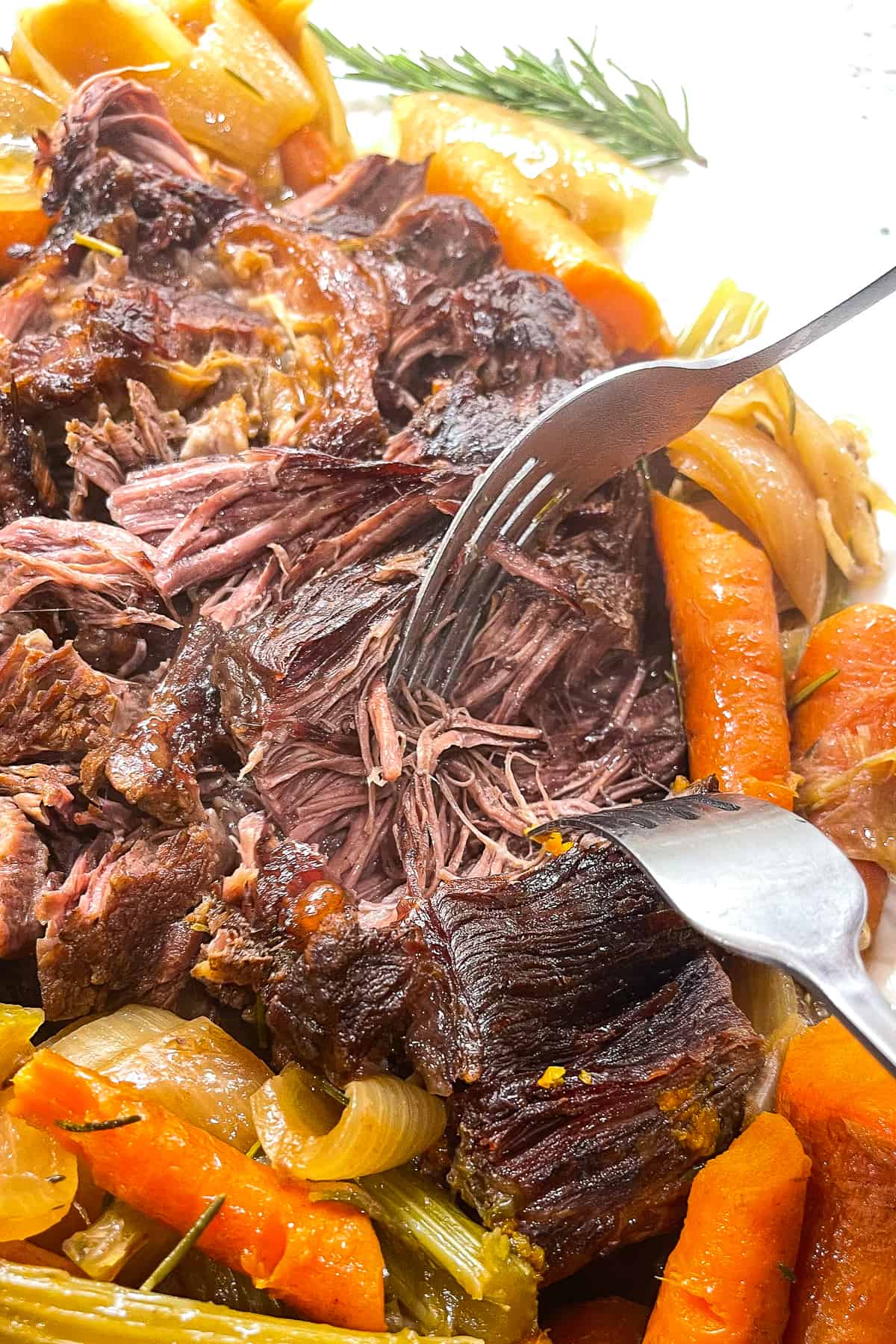
- Melt-apart, fork-tender beef: Low and slow cooking breaks down the tough connective tissue in chuck roast into velvety, collagen-rich gelatin, giving you meat that falls apart in the most satisfying way possible.
- A gravy that is genuinely outstanding: The braising liquid transforms into a restaurant-worthy, deeply savory gravy with just a few minutes of stovetop reduction — it is rich, glossy, and packed with concentrated beefy flavor.
- Built-in side dish: Carrots, potatoes, and onions cook right alongside the beef, absorbing all those incredible braising juices and becoming deeply flavorful and perfectly tender.
- Better the next day: Like most braises, the flavors deepen overnight, making leftovers arguably more delicious than the original meal.
- Crowd-pleasing and comforting: This is the kind of food that makes people genuinely happy — universally loved, deeply satisfying, and impressive without requiring any culinary acrobatics.
Key Ingredients
The foundation of this recipe is a bone-in or boneless chuck roast — specifically, a well-marbled cut from the shoulder that is loaded with connective tissue and intramuscular fat. That fat and collagen are not flaws; they are the entire reason this roast becomes so extraordinarily tender and flavorful after hours of slow cooking. Do not be tempted to substitute a leaner cut like round roast — it simply will not deliver the same silky, pull-apart result. A generous hit of Worcestershire sauce in the braising liquid does something remarkable: it adds a deeply savory, almost umami-like complexity that amplifies the beefy flavor without announcing itself overtly. You taste it as depth rather than as a distinct ingredient. Tomato paste plays a similar role — sautéed briefly before being added to the liquid, it brings a subtle richness and body to the braise that rounds out the savory edges beautifully. The root vegetables — chunky carrots, Yukon gold potatoes, and sweet yellow onions — are not just a side dish; they are integral to the character of the braise, releasing their natural sugars into the cooking liquid as the hours pass and absorbing the meaty, herb-laced juices in return. Finally, a generous handful of fresh thyme and rosemary, along with a few smashed garlic cloves, perfume the entire dish with an aromatic warmth that ties everything together. Good beef broth — low-sodium, so you can control the salt — forms the backbone of the braising liquid and ultimately becomes your gravy, so quality matters here.
Pro Tips & Variations
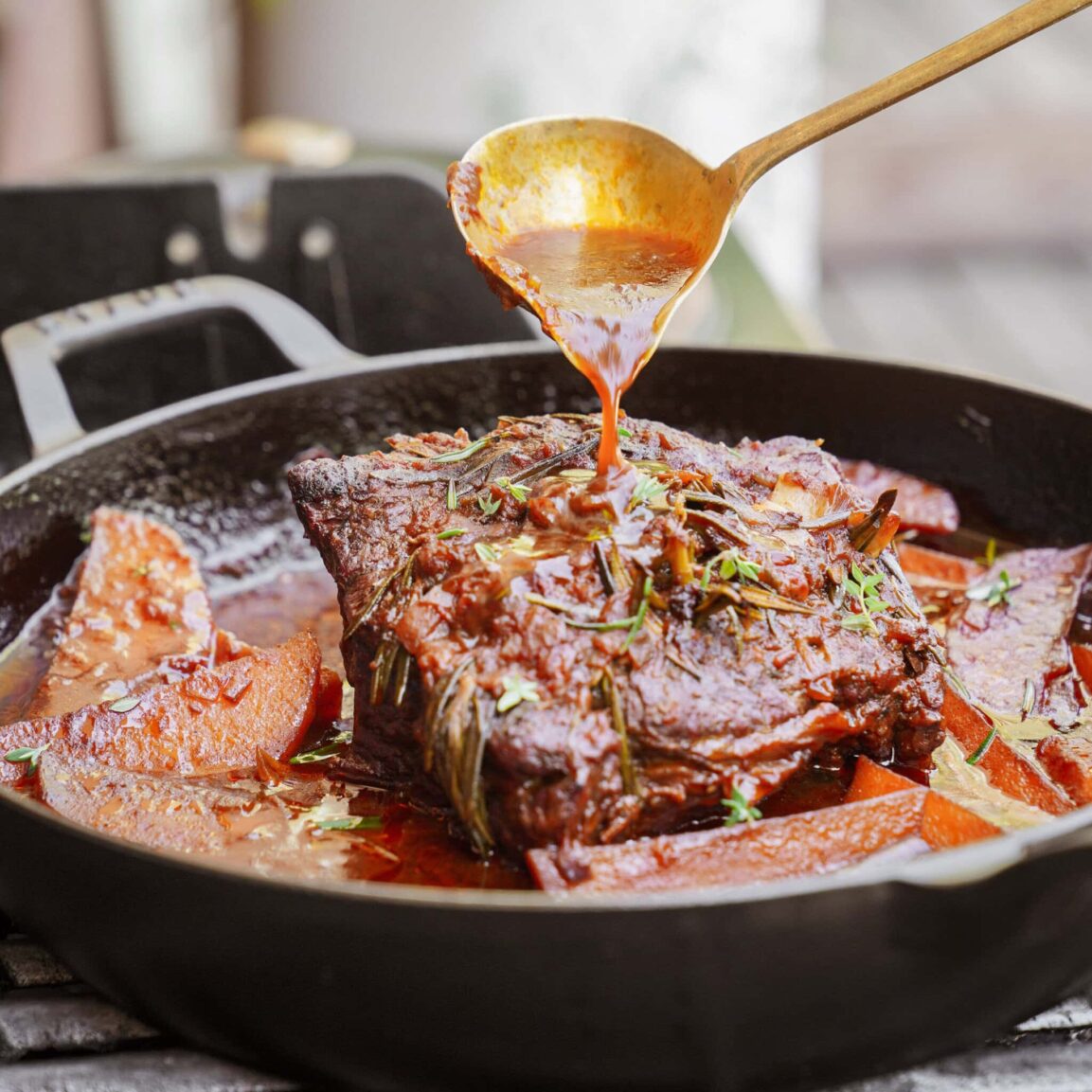
- Do not skip the sear. This is the single most important step in the entire recipe. Patting the chuck roast completely dry and searing it in a screaming-hot cast iron skillet until you have a deeply browned crust on all sides — including the ends — creates Maillard reaction compounds that translate directly into flavor complexity in the finished dish. A pale, unseared roast will taste flat by comparison. Serious Eats has an excellent deep-dive on why browning meat properly is so critical to depth of flavor.
- Sauté the aromatics and tomato paste first. After searing the beef, cook the onions, garlic, and tomato paste in the same skillet for two to three minutes before adding the broth to deglaze. This extra step — which adds maybe five minutes — builds exponential flavor into your braising liquid.
- Layer strategically: Place root vegetables on the bottom of the slow cooker insert (they need direct heat contact), nestle the seared roast on top, and pour the braising liquid around — not over — the beef so the top continues to develop that browned, meaty character during cooking.
- Low and slow wins: Cook on LOW for 8 to 10 hours rather than HIGH for 4 to 5. The lower temperature gives collagen more time to properly convert to gelatin, resulting in noticeably silkier, more tender meat.
- Make the gravy properly. After cooking, transfer the braising liquid to a small saucepan, whisk in a slurry of cornstarch and water, and simmer until glossy and thickened. This step is what separates a truly memorable pot roast from a merely good one.
- Red wine variation: Substitute one cup of the beef broth with a full-bodied red wine (Cabernet Sauvignon or Merlot work beautifully) for a richer, more complex braising liquid with a subtle wine-forward depth. If you love bold braises like this, you will appreciate how similar technique creates magic in our Coq au Vin as well.
- Add mushrooms: Cremini or button mushrooms added in the last two hours of cooking contribute a deeply earthy, umami-rich note that pairs beautifully with the beef.
- Make it ahead: This pot roast is genuinely better the next day. Cool, refrigerate overnight, skim the solidified fat from the surface, and reheat gently — the flavors will be even more concentrated and harmonious. For more deeply satisfying beef-forward comfort, our Hungarian Goulash scratches a very similar itch.
Nutritional Highlights
A serving of this Slow Cooker Pot Roast delivers a genuinely satisfying and protein-rich meal. Chuck roast is an excellent source of high-quality protein — essential for muscle repair and sustained energy — along with meaningful amounts of zinc, iron, and B vitamins, particularly B12, which supports nerve function and energy metabolism. The root vegetables contribute complex carbohydrates, dietary fiber, potassium, and beta-carotene (from the carrots), making this a well-rounded, nutritionally complete dinner rather than just a comfort food indulgence. Food Network’s pot roast collection offers additional inspiration if you want to explore variations. The long braising process also extracts collagen from the beef, which breaks down into gelatin in the cooking liquid — contributing to that silky gravy texture while providing potential benefits for joint and gut health. This is, unambiguously, the kind of meal that nourishes as deeply as it satisfies.
Frequently Asked Questions
Can I make Slow Cooker Pot Roast ahead of time?
Absolutely — in fact, we actively encourage it. Pot roast belongs to a category of braises that improve significantly after resting overnight. The muscle fibers relax further as the dish cools, the flavors meld and concentrate, and any excess fat rises to the surface of the liquid and solidifies into an easy-to-remove layer. To make ahead, allow the finished roast to cool completely, transfer everything (meat, vegetables, and braising liquid) to an airtight container or leave it in the slow cooker insert covered, and refrigerate for up to three days. When ready to serve, skim the solidified fat from the surface of the liquid, transfer the liquid to a saucepan to make your gravy, and gently reheat the meat and vegetables in the gravy over low heat or in a 300°F oven covered with foil until warmed through. The result is often even more deeply flavorful than the day it was made.
What cut of beef is best for pot roast?
Chuck roast is definitively the best cut for pot roast, and we say this without reservation. The chuck comes from the shoulder area of the cow, and it is naturally well-marbled with fat and loaded with collagen-rich connective tissue. During long, slow cooking, that fat renders into the braising liquid (enriching it enormously), and the collagen converts to silky gelatin — which is why fork-tender pot roast has that characteristic melt-in-your-mouth quality that lean cuts simply cannot replicate. Avoid the temptation to use eye of round, top round, or bottom round — these lean cuts will dry out and become tough rather than tender under the same conditions. If you absolutely cannot find chuck roast, brisket (flat cut) is the only acceptable substitute, as it has a similar fat-to-muscle ratio and will respond well to the same low-and-slow braising technique.
How do I store and reheat leftover pot roast?
Leftover pot roast stores beautifully. Transfer the meat, vegetables, and gravy together into an airtight container — keeping everything submerged in the gravy prevents the meat from drying out — and refrigerate for up to four days. For longer storage, pot roast freezes exceptionally well: portion into freezer-safe containers with gravy, freeze for up to three months, and thaw overnight in the refrigerator before reheating. To reheat, the best method is low and slow on the stovetop: add the pot roast and gravy to a Dutch oven or heavy saucepan, cover, and warm over low heat for 15 to 20 minutes, adding a splash of beef broth if the gravy has thickened too much during storage. You can also reheat covered in a 300°F oven for about 20 to 25 minutes. Avoid the microwave if possible — while convenient, it can make the meat slightly rubbery and uneven. Serve leftovers over mashed potatoes, in sandwiches, or shredded into tacos for a genuinely spectacular second meal.
Make It, Share It, Save It
This Slow Cooker Pot Roast is the kind of recipe that earns a permanent place in your rotation — the one you come back to every fall and winter, the one that makes your home smell incredible, the one people ask for again and again. It is bold, deeply savory, achingly tender, and finished with a gravy that is genuinely worth making. If you are a fan of deeply satisfying, slow-cooked comfort food, you might also love our Cuban Ropa Vieja — another fork-shredded beef classic with bold, complex flavors that reward the patient cook. If you make this pot roast, please leave a comment below and let us know how it turned out — we love hearing from you. Share it with someone who needs a little comfort food in their life, pin it for your next cozy Sunday dinner, and save it somewhere you will actually find it again. You are going to want it back.
Find the complete recipe card below ↓
Slow Cooker Pot Roast
Equipment
- 6-quart slow cooker
- Large cast iron skillet
- Medium saucepan
- Wooden spoon
- Whisk
- Measuring cups and spoons
- Cutting board
- Tongs
Ingredients
For the Pot Roast
- 3.5 lbs chuck roast boneless, well-marbled, patted completely dry
- 2 tsp kosher salt plus more to taste
- 1 tsp black pepper freshly ground
- 1 tsp garlic powder
- 2 tbsp vegetable oil or other high-smoke-point oil
- 1 tbsp tomato paste
- 4 cloves garlic smashed and peeled
- 1 large yellow onion roughly chopped into large chunks
- 4 medium carrots peeled, cut into 2-inch chunks
- 1.5 lbs Yukon gold potatoes halved or quartered if large
- 2 cups low-sodium beef broth
- 2 tbsp Worcestershire sauce
- 1 tbsp soy sauce low-sodium
- 4 sprigs fresh thyme
- 2 sprigs fresh rosemary
- 2 whole bay leaves
For the Gravy
- 2 tbsp cornstarch
- 2 tbsp cold water
- 1 tbsp unsalted butter optional, for extra richness
- salt and pepper to taste
Instructions
Sear the Chuck Roast
- Pat the chuck roast completely dry with paper towels on all sides — this is essential for a proper sear. Season generously all over with kosher salt, black pepper, and garlic powder, pressing the seasoning in firmly.
- Heat the vegetable oil in a large cast iron skillet or heavy-bottomed pan over high heat until shimmering and just starting to smoke. Add the chuck roast and sear without moving for 4 to 5 minutes per side, including the short ends, until a deep mahogany crust forms on all surfaces. Transfer the seared roast to the slow cooker insert.
Build the Braising Liquid
- Reduce the skillet heat to medium. Add the onion chunks and smashed garlic to the same pan (do not wipe it out — those browned bits are gold). Cook for 2 minutes, stirring occasionally, until softened and fragrant.
- Add the tomato paste and stir into the onions and garlic. Cook for 1 to 2 minutes until the tomato paste darkens slightly and begins to stick to the pan.
- Pour the beef broth into the skillet and use a wooden spoon to scrape up every browned bit from the bottom of the pan. Add the Worcestershire sauce and soy sauce, stir to combine, and bring to a brief simmer. Remove from heat.
Assemble the Slow Cooker
- Arrange the carrot chunks and halved potatoes on the bottom and sides of the slow cooker insert around the seared roast.
- Pour the braising liquid from the skillet around (not over) the roast. Tuck the thyme sprigs, rosemary sprigs, and bay leaves into the liquid around the beef.
- Place the lid on the slow cooker and cook on LOW for 8 to 10 hours, or until the beef is completely fork-tender and falls apart easily when pressed. Do not cook on HIGH if you want the best texture — low and slow is non-negotiable for true tenderness.
Make the Gravy
- Carefully transfer the cooked beef to a cutting board and the vegetables to a serving platter. Remove and discard the thyme sprigs, rosemary sprigs, and bay leaves.
- Pour the braising liquid from the slow cooker into a medium saucepan. Bring to a simmer over medium-high heat.
- In a small bowl, whisk together the cornstarch and cold water until completely smooth to form a slurry. While stirring the simmering braising liquid, slowly pour in the cornstarch slurry. Continue to simmer, stirring frequently, for 3 to 5 minutes until the gravy thickens to a glossy, coating consistency. Stir in the butter if using, taste, and adjust salt and pepper.
Serve
- Using two forks or your hands, gently pull the chuck roast into large, rustic chunks — it should fall apart effortlessly. Arrange the beef on the serving platter with the vegetables, ladle the gravy generously over everything, and garnish with a few fresh thyme leaves. Serve immediately with crusty bread or creamy mashed potatoes for soaking up every drop of that gravy.